

Parramatta Light Rail Stage 1

By 2026, the Parramatta Light Rail (PLR) project anticipates a daily patronage of around 28,000 people with an estimated 130,000 people living within walking distance of the 16 light rail stops. PLR will reduce the need for people to travel by car around the Greater Parramatta region, taking the equivalent of 25,000 cars off the road by 2041.
Parramatta Light Rail Innovations
The Parramatta Light Rail (PLR) Stage 1 project continues to deliver beneficial, measurable, and enduring outcomes for the natural environment, through innovations such as:
An Australian-first encapsulating rail boot system to reduce operational noise and vibration
The use of macro synthetic fibres in the concrete track slab to reduce steel reinforcement and increase durability
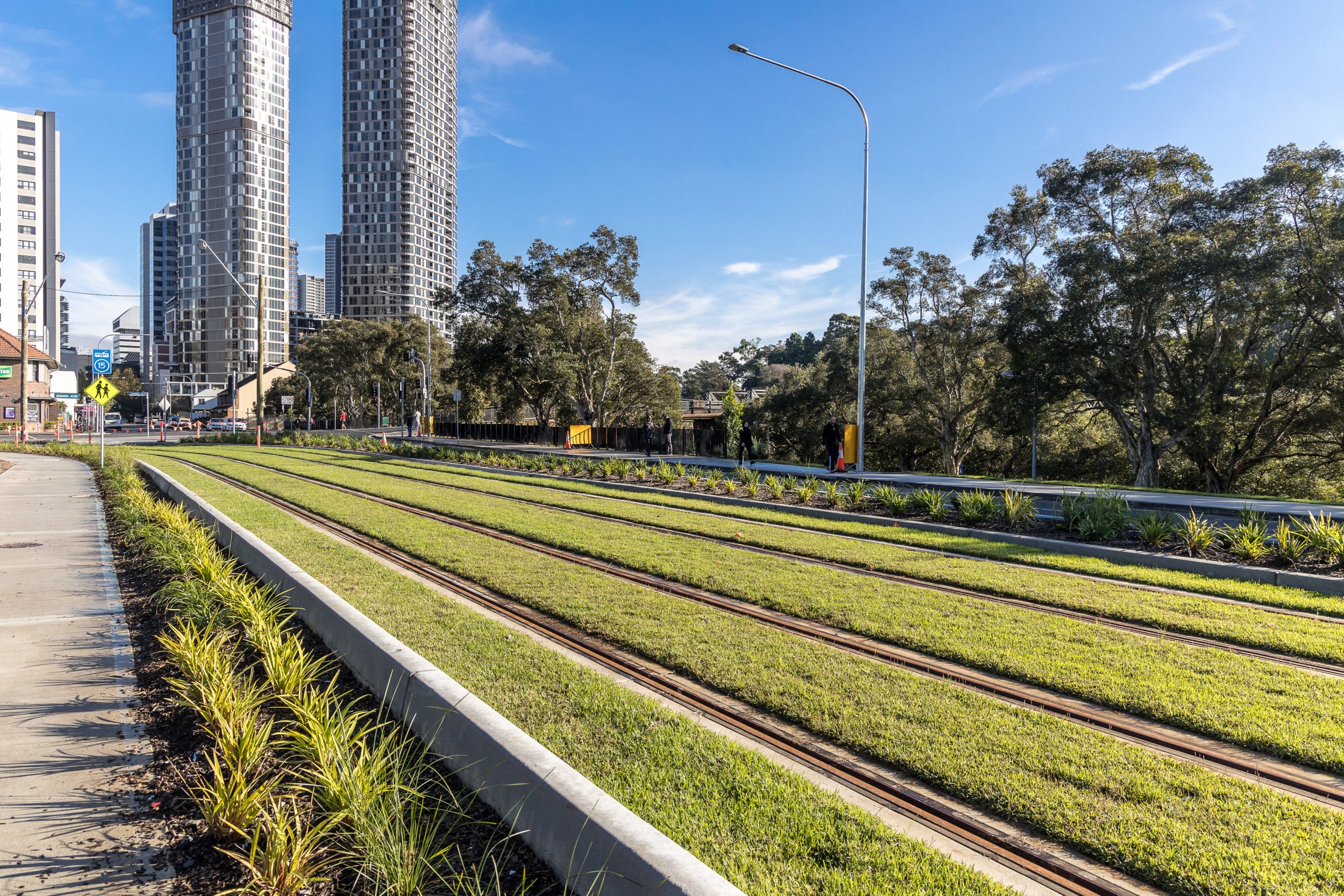
NSW’s first ‘green track’ on a light rail project, to reduce noise and urban heat while integrating with heritage and sensitive environments
Environmental benefits
-

Environmental benefits were realised early on with the recycling of the track, ballast, and sleepers from the former T6 Carlingford Line eliminating the need to manufacture new rail and transport it to site. This resulted in reduced manufacturing, logistics and storage costs.
Overall, the project has achieved:
Re-use of more than 50% of the ballast, 60% of the rail and 90% of the sleepers extracted from the original single-track T6 line
1,000+ tonnes of recycled glass in asphalt
25,000+ m2 of existing asphalt milled and re-sheeted rather than removing and rebuilding the entire profile
6,000+ tonnes of recycled asphalt pavement in asphalt works
100% of usable spoil on the project reused
95%+ of topsoil reused in landscaping works
40% of aggregates recycled
99% of construction and demolition waste recycled, avoiding 145,906+ tonnes of waste in landfill
36% reduction in carbon emissions through construction and operations
The project’s infrastructure works package received an Infrastructure Sustainability Council (ISC) As-Built rating of 104.35. It is the highest score awarded to a project to date in Australia, demonstrating PLR’s commitment to creating a lasting legacy through integrating positive economic, social, and environmental outcomes in the design and construction of PLR.

Urban revitalisation
The project has produced a high-quality urban realm finish that is sympathetic to Parramatta's heritage and cultural fabric, including using a wire-free design over much of the alignment and using green track.
The shared pedestrian and light rail zone in Parramatta’s CBD has revitalised the Church Street dining and entertainment precinct and created a car-free zone with the addition of new outdoor structures and landscaping.
A focus on innovative thinking, prudent risk management and close stakeholder collaboration allowed the PLR project to leverage opportunities to mitigate environmental and community impacts and provide sustainable solutions without detriment to operational use.
These initiatives included:
-
The recycling and re-purposing of materials throughout the construction of the light rail involved investigating and using recycled products in asphalt, recycled aggregates, re-use of existing base/sub-base material in road pavement, supplementary cementitious materials in concrete and reusing usable spoil within the alignment.
-
A NSW-first innovation was the use of macro synthetic fibres within the light rail concrete track. This increased concrete durability and performance, enabled more efficient construction, and mitigated potential stray current issues.
-
An Australian-first innovation was achieved with the use of an enhanced, more rigid, encapsulating rail boot system. The bespoke boot made the requirement of a floating track slab redundant as it provided a complete system for rail resistivity, stray current and noise and vibration attenuation requirements.
-
A micro-tunnel design was used under Church Street to enable more storm drainage capacity within the Parramatta CBD. The solution minimised business impacts on the key dining precinct, limited the number of utility relocations and was a key energy and water-saving initiative for the project.
-
To minimise the time and risk associated with utility relocations, the project team used digital modelling from the site investigation program and the use of augmented reality to coordinate the 3D model.
-
PLR’s 5.7-kilometre Active Transport Link has opened, connecting people to local transport, businesses and communities. The track is lit by dimmable, motion-sensor LED lighting, which reduces energy and maintenance costs while also supporting public safety.
-
In a NSW-first innovation, PLR designed and integrated a total of 1.3 kilometres of green track within three heritage-sensitive environments along the PLR alignment. Green track requires 81% less concrete compared to standard embedded track form.
-
Through the Tree Offset Strategy, the project is delivering revegetation actions throughout the Parramatta Local Government Area increasing tree individuals by 5,500+, thereby improving urban heat, community health and increasing habitat for local fauna.
-
To minimise impacts on a significant Grey-headed Flying Fox (GHFF) camp within Parramatta Park, the project developed and implemented a specific Construction Monitoring Program to observe and track the behaviour of the camp throughout construction. The program used a tiered approach of regular monitoring by an experienced fauna specialist and trained project staff, activity-based monitoring during higher-risk activities and a stress-response plan in the event of emergencies. The program was used as a successful example of how to minimise impacts on this protected species in an Australian Government best practice guideline.
-
In a NSW-first, the project team used a weathered steel solution for the long-span steel through truss structure, which will minimise future maintenance and disruption to rail operations. The installation approach was also innovative with the use of a self-propelled gantry system to lift the bridge deck and roll it across James Ruse Drive to its final seating position completed in a single overnight road occupation.
-
As Australia’s second oldest city, Parramatta has a rich and varied history of Aboriginal and European significance. This unique history was respected in bespoke designs, developed in consultation with Heritage NSW, such as using wire-free operations in heritage areas, thin resin-bound footpath pavements to avoid disturbing unmarked graves, avoiding unnecessary removal of heritage bridge abutments, lighting solutions to minimise visual clutter and salvage/reuse of sandstone and bricks.
-
Heritage interpretation was incorporated into the design including paving inlays, interpretive signage, landscaping and an indigenous garden.
Archaeological findings were shared with the community in a series of online webinars, and in 2022 more than 1,000 locals and visitors to Parramatta took the opportunity to immerse themselves in the Parramatta Light Rail Heritage exhibition: A Journey through Time.
The free exhibition, which ran for three months, featured local historical information and artefacts that had been carefully uncovered and preserved during the construction of PLR.
Innovation benefits
-

Bidgee Bidgee Bridge
PLR saw the construction of the second-largest steel arch bridge in NSW. The project team worked closely with S&L Steel Group Pty Ltd, based in Western Sydney, through the complex tender review process to ensure they were capable of delivering the scope.
Their performance on PLR has proven that S&L has the capability to deliver large projects, and will improve their ability to secure future work. Delivering Bidgee Bidgee Bridge also provided opportunities for the S&L workforce who lived and worked in the project area.
-

Aboriginal participation spend
PLR’s two main works contractors, Parramatta Connect and Great River City Light Rail partnered along with ICN to hold a subcontractor forum for SMEs, Aboriginal businesses, and social enterprises, who were provided with information on potential tender and supply chain opportunities.
Examples of Supply Nation Certified Indigenous businesses that worked on the project include:
• Borger Cranes, who secured the contract for the supply of heavy lift cranes in one of the sections of the project
• New Start was awarded the contract to supply and install street furniture across the project alignment
• Project catering for most project functions was procured from Aboriginal owned and operated Kallico Catering
For the Infrastructure Works alone, Aboriginal participation spend exceeded its target by nearly $7m and had a social enterprise spend of over $2.3m.
-

Social outcomes
The PLR project achieved strong positive social outcomes through the creation of jobs and employment opportunities:
53.7% of trades roles were apprentices (target 20%)
39% were learning workers (target 20%)
14.6% of the workforce was under the age of 25 (target 8%)
2.6% of the workforce were women in non-traditional roles (target 2%)
2.4% of the workforce were Aboriginal people (target 2.5%)
4.2% of the overall workforce were from disadvantaged, disabled and underrepresented groups (target 5%)
Seven employees gained Certificate II in Civil Construction after completing a program providing opportunities for Indigenous Australians, refugees and asylum seekers.
Legacy and UN SDG Contribution
-

SDG8 – Decent work and economic growth
This SDG aims to promote sustained, inclusive and sustainable economic growth, full and productive employment and decent work for all. PLR has achieved these goals through the support of small businesses along the alignment, helping them stay open and employ people from the local community.
-
SDG11 – Sustainable Cities and Communities
This SDG aims to make cities and human settlements inclusive, safe, resilient and sustainable. By helping the businesses along the PLR alignment stay open and vibrant during construction, TfNSW has contributed to making the city of Parramatta resilient and sustainable.
-

‘Activate Parramatta' initiative
TfNSW launched ‘Activate Parramatta’, an initiative for businesses impacted by the PLR construction, to bring life and vitality across the alignment by promoting local businesses, events and activities, including shop local campaigns. Dedicated Place Managers engaged directly with local businesses along the route to provide information and assistance, and to answer questions about the impacts of construction, such as wayfinding, noise and vibration, and access for deliveries and customers.
This content is derived from an Infrastructure Sustainability Council Gala Awards Submission. For more details, please visit the ISC Case Studies.